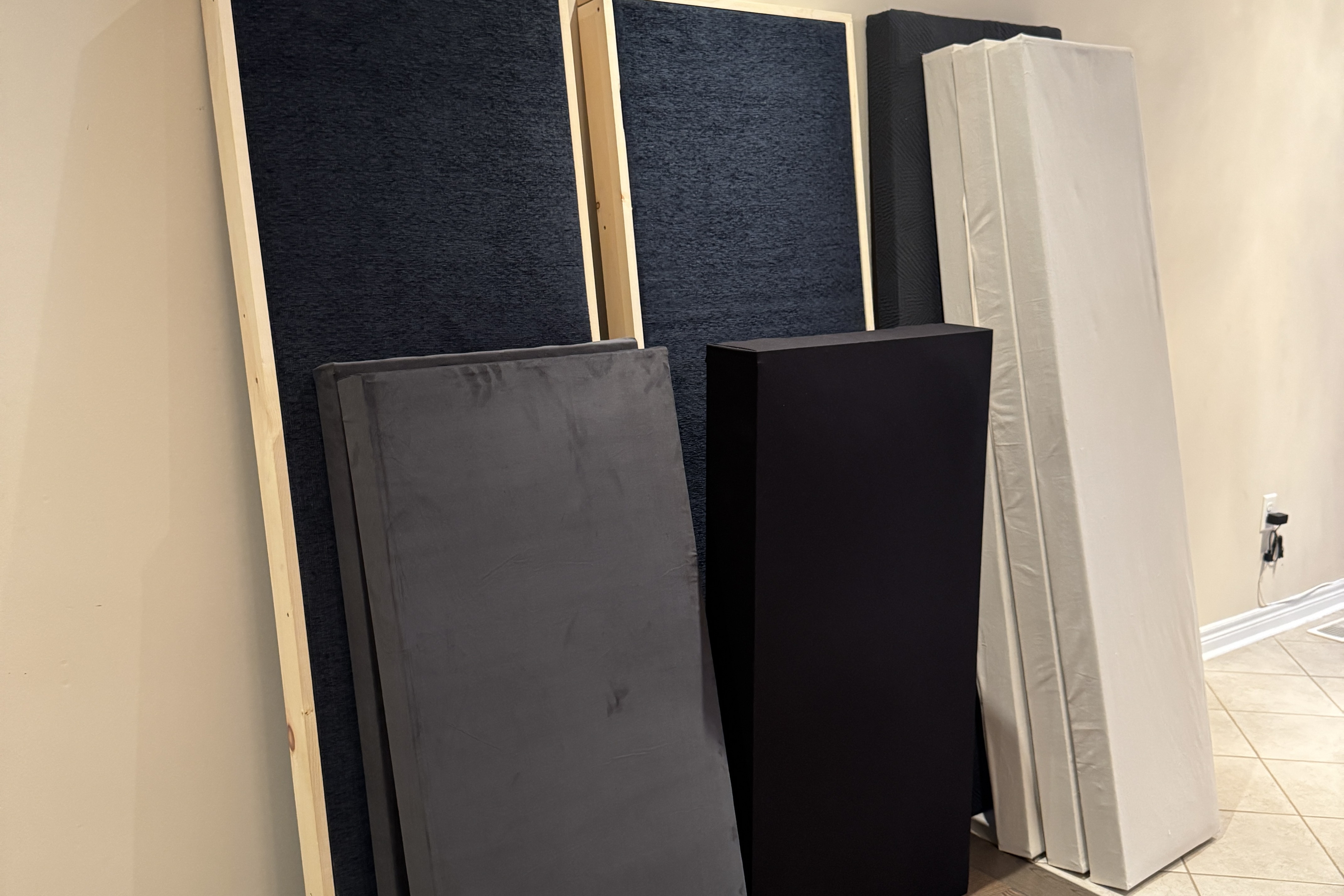
Acoustic panel thickness has a major effect on performance. While all absorptive panels can help reduce reflections, thicker panels usually absorb a wider range of frequencies.
Choosing the right thickness depends on the room, the acoustic problem, and how the space will be used.
Thin Panels
Thin panels, including many foam products, mainly absorb higher frequencies.
They can help reduce:
- Flutter echo
- Harsh reflections
- Excessive brightness
- Light vocal reflections
However, thin panels usually provide limited control of lower-mid and bass frequencies. This means a room may sound less bright while still feeling muddy, boomy, or uneven.
Thin panels may be suitable for light acoustic treatment, temporary setups, or spaces where wall depth is limited.
3.5- to 4-Inch Panels
Panels around 3.5 to 4 inches thick are a practical choice for many rooms.
They can absorb high frequencies while also providing better control of lower-mid frequencies. This makes them suitable for:
- Recording studios
- Podcast rooms
- Offices
- Classrooms
- Home theatres
- Rehearsal spaces
- Restaurants
This thickness provides a good balance between acoustic performance, wall space, weight, and appearance.
For many residential and commercial rooms, a well-built 3.5- or 4-inch panel offers noticeably broader absorption than thin decorative foam.
Thicker Panels and Bass Traps
Rooms with strong low-frequency problems may require thicker treatment.
Bass frequencies are more difficult to absorb because their wavelengths are much longer. Standard wall panels can help with some lower-mid frequencies, but dedicated bass traps are usually more effective for controlling deeper bass.
Thicker panels are especially useful in rooms with:
- Subwoofers
- Drums
- Bass amplifiers
- Large studio monitors
- Home theatre systems
- Mixing and mastering setups
Bass traps are commonly installed in corners, where low-frequency pressure often builds up.
The Benefit of an Air Gap
A small air gap behind an acoustic panel can improve its performance.
Mounting a panel slightly away from the wall increases its effective treatment depth. This can improve absorption at lower frequencies without requiring a physically thicker panel.
For example, a 4-inch panel with an air gap may provide broader absorption than the same panel mounted directly against the wall.
The gap should still allow the panel to be mounted safely and securely.
Final Thoughts
Panel thickness should be chosen based on performance, not appearance alone.
Thin panels may help with high-frequency reflections, while 3.5- to 4-inch panels provide more balanced absorption for many common applications. Thicker panels and bass traps are better suited to rooms with stronger low-frequency problems.
The internal material, construction quality, placement, and mounting method also affect the final result. A properly built panel with suitable thickness will provide more useful acoustic control and create a clearer, more comfortable room.